Managing ADHD at Work Complete Guide Beyond Medication
Learn how to manage ADHD at work beyond medication. Discover executive function strategies and time-management techniques to boost focus and career performance.
For adults with ADHD, the professional world often feels like navigating a labyrinth designed for someone else. You're likely here because you've experienced the unique challenges—from struggling to maintain focus in long meetings to grappling with the emotional weight of feedback—and you're seeking more than just surface-level coping mechanisms. You're evaluating strategies that offer real, sustainable change, empowering you to thrive without solely relying on medication.
Many resources offer general tips, or delve into the medical aspects, but they often miss a crucial truth: managing ADHD in a professional context isn't just about reducing symptoms; it's about developing a sophisticated skill set. This journey isn't passive; it’s an active process of reframing, learning, and applying targeted techniques to transform perceived weaknesses into professional assets.
Traditional narratives often frame ADHD as a deficit, something to be 'fixed' or 'managed' through medication alone. While medication is a valid and effective tool for many, a significant portion of adults with ADHD are actively seeking non-pharmacological interventions. Data highlights the urgency here: around 16.13 million adults in the US are projected to have ADHD in 2025, yet a staggering 87% of them experience career struggles. Adults with ADHD are 30% more likely to face chronic employment issues, 60% more likely to be fired, and three times more likely to quit impulsively compared to their neurotypical peers. Moreover, the unemployment rate for adults with ADHD is 8%, significantly higher than the national average, and they earn about 17% less than their neurotypical counterparts with similar education.
These statistics aren't meant to discourage, but to underscore a vital point: there's immense untapped potential. The solution isn't just basic 'coping' strategies. It's about developing a suite of sophisticated, evidence-informed skills that address the core challenges while leveraging the unique strengths often associated with the ADHD brain – creativity, hyperfocus when engaged, and dynamic thinking. Studies confirm that non-pharmacological approaches like Cognitive Behavioral Therapy (CBT), mindfulness, structured routines, and executive function coaching are highly effective.
Instead of viewing ADHD as purely a hurdle, we champion a "skill-first, not symptom-last" approach. We believe ADHD management is about cultivating a unique toolkit of professional skills that empower you to not just survive, but truly excel.
Executive functions—the cognitive processes that help you plan, focus, remember instructions, and juggle multiple tasks—are often where ADHD symptoms manifest most acutely in the workplace. Many resources provide basic organizational tips, but our focus is on developing actionable methodologies that go beyond simple checklists.
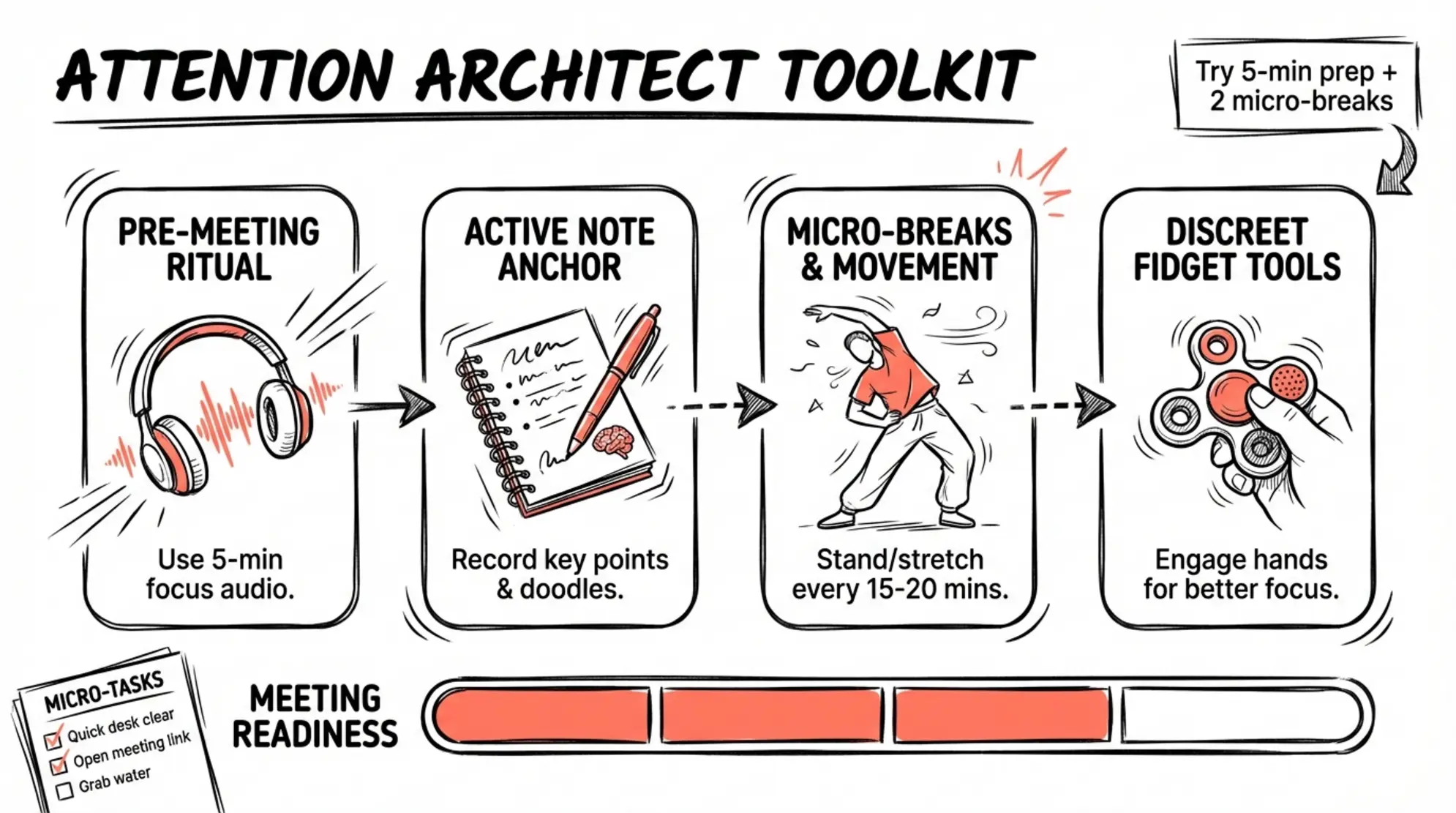
Long meetings can be a particular minefield for ADHD professionals. The passive nature, information overload, and lack of immediate engagement can quickly lead to mind-wandering. Instead of simply trying to 'pay attention,' we advocate for becoming an 'Attention Architect,' proactively designing your focus.
Here’s a comparison of four evidence-informed, non-pharmacological strategies to help you decide which skill-building path fits your role and priorities:

Toolkit Components:
Here's a concise, stepwise meeting toolkit that turns these evidence-based attention strategies into simple actions for immediate use:

Time blindness, the difficulty in accurately perceiving the passage of time or estimating how long tasks will take, is a hallmark of ADHD. This can make meeting deadlines an anxiety-inducing sprint rather than a planned execution. We focus on advanced techniques to build a more accurate internal clock and manage projects.
Emotional dysregulation and Rejection Sensitive Dysphoria (RSD) are often profound, yet less openly discussed, challenges for ADHD professionals. These aren't just personal struggles; they significantly impact professional interactions, team dynamics, and career progression. Most resources offer general advice; we provide targeted frameworks for these complex emotional responses.
Impulsivity isn't just about interrupting; it can manifest as blurting out thoughts, reacting emotionally to feedback, or making hasty decisions. Developing impulse control in a professional setting is a critical skill for building trust and maintaining effective communication.
RSD, the intense emotional pain felt when experiencing or perceiving rejection, criticism, or failure, can be debilitating in the workplace. It can lead to people-pleasing, avoidance of new challenges, or aggressive reactions to feedback. Managing RSD proactively builds significant career resilience.
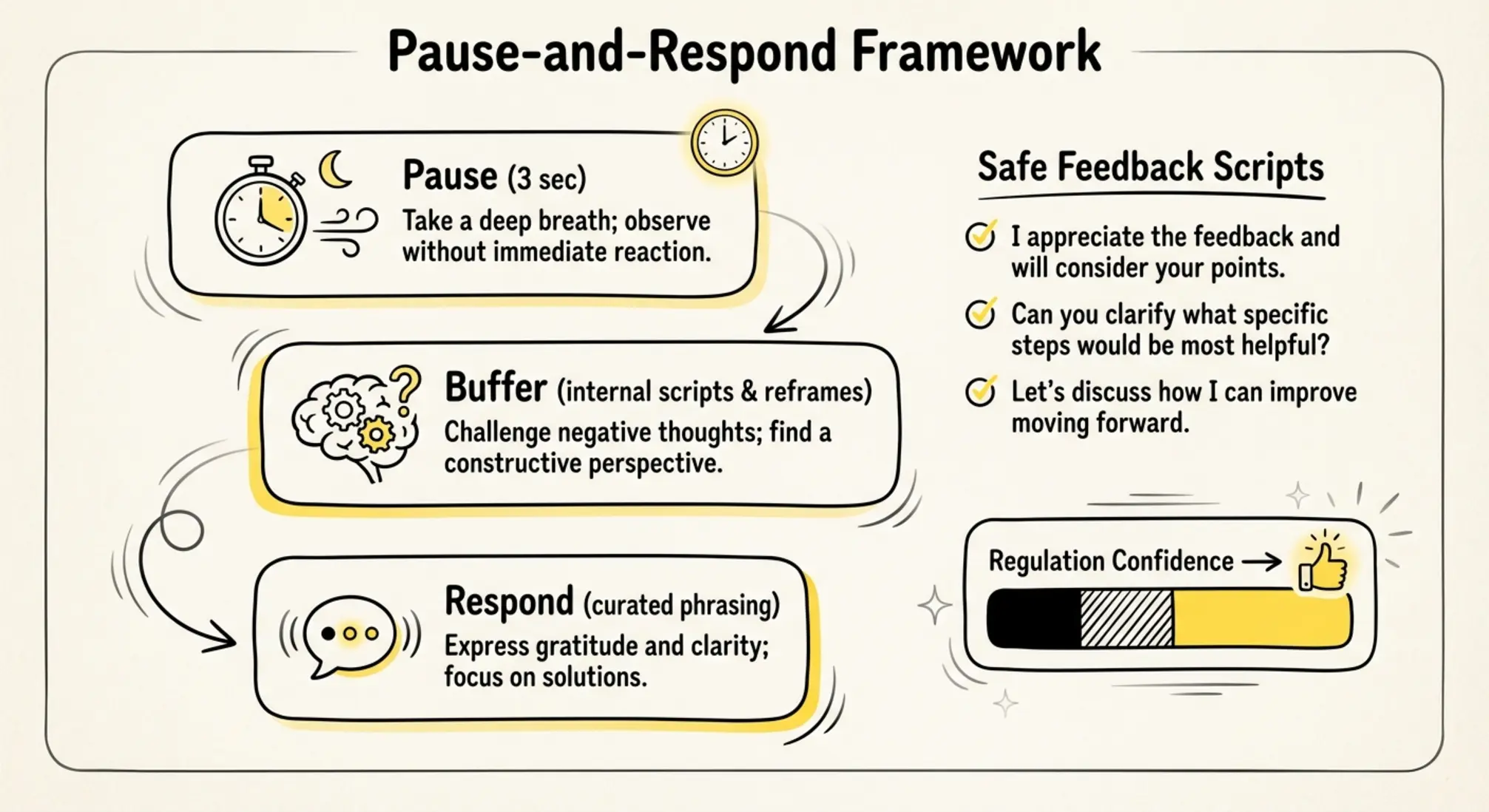
Here’s a simple, workplace-tailored emotional regulation pathway and script bank to manage RSD and respond to feedback with clarity and confidence:
Hyperactivity often conjures images of restless children, but in adults, it frequently manifests as an "internal motor"—racing thoughts, a need for constant stimulation, or restlessness. Instead of fighting this energy, we can channel it productively, optimizing your environment to support your natural work style.
Sustaining professional performance with ADHD isn't just about targeted strategies; it's also built on a foundation of holistic well-being. This integrates lifestyle elements often overlooked in ADHD workplace advice.
Mindfulness and CBT are powerful tools for managing the internal landscape of ADHD, fostering mental agility, and reducing anxiety often co-occurring with ADHD.
Clear, research-backed metrics indicate the scale of workplace impact and the relative effectiveness of skill-based interventions. Use this data to prioritize your approach:
Absolutely. While medication can be highly effective for many, numerous non-pharmacological strategies—including executive function coaching, CBT, mindfulness, and environmental adaptations—have strong evidence of success in improving professional performance and well-being for adults with ADHD. The key is skill development and consistent application.
Start by identifying your most significant professional challenges. Is it focus in meetings? Meeting deadlines? Managing emotional responses? Begin with the strategies that address your top 1-2 pain points. Experiment, track your progress, and adjust. Formal assessment with an ADHD coach can also provide personalized recommendations for skill-building.
Not necessarily. Many of these strategies are beneficial for anyone seeking to improve productivity or emotional regulation and can be implemented discreetly. For example, using a standing desk or a visual timer doesn't require disclosure. If you require formal accommodations under the ADA, or wish to seek support from your employer, disclosing professionally can be beneficial. CHADD provides excellent resources on your rights and how to approach these conversations.
Like any skill development, consistency is key. You might notice small improvements in a few weeks, but significant, lasting change typically requires dedicated practice over several months. Celebrate small wins and focus on gradual progress rather than instant perfection.
Reputable organizations like CHADD.org and ADD.org offer extensive resources and often directories for ADHD coaches. Online platforms also provide structured courses and communities for deeper dives into CBT and mindfulness specifically tailored for ADHD.
Managing ADHD in the professional context is less about 'fixing' a problem and more about mastering a unique way of being and processing information. The strategies we've discussed are not quick fixes but powerful tools for building lasting skills. By embracing these evidence-informed approaches, you can transform your professional journey from one of struggle to one of strategic excellence.