ADHD Innovation Guide to Unleashing Problem Solving
Learn how to turn ADHD into a competitive edge for innovation and problem solving. Discover proven strategies, hyperfocus techniques, and workplace tips now.

You’re evaluating solutions, weighing options, perhaps considering how your unique cognitive profile or that of a colleague or team member fits into the complex demands of the modern professional landscape. If you're encountering ADHD, you've likely seen content that frames it as a list of challenges to overcome. But what if we told you that perspective misses the most powerful part of the equation?
The truth is, while approximately 16.13 million U.S. adults are estimated to have ADHD, with a staggering 87% experiencing career struggles, nearly 98% of these same individuals recognize profound workplace strengths stemming from their condition. This isn't just about coping; it's about competitive advantage. This guide will help you understand how the ADHD brain, often mischaracterized, is actually a powerful engine for innovation and agile problem-solving, offering concrete pathways to harness these strengths in professional contexts.
Forget what you think you know about ADHD. This isn't a deficit of attention; it's a difference in how attention is regulated and directed. Research shows that ADHD brains have distinct patterns, particularly in dopamine regulation and neural pathways, which, while sometimes leading to challenges like distractibility or time-blindness, also underpin extraordinary cognitive gifts.
These differences aren't flaws. They're mechanisms for a style of thinking that naturally favors:
Instead of seeing these as mere traits, recognize them as the fundamental wiring for innovation. It's the reason why individuals with ADHD frequently demonstrate "out-of-the-box" thinking, offering fresh perspectives crucial for fast-paced or experimental work. You're not just managing a condition; you're cultivating a powerful cognitive toolkit.
One of the most misunderstood, yet potent, ADHD traits is hyperfocus. Often seen as accidental or inconvenient, hyperfocus is, in fact, a profound ability to achieve intense, prolonged concentration on tasks that are interesting, challenging, or engaging. Research confirms hyperfocus is more common in ADHD populations and directly correlatable to productivity and skill attainment.
This intense focus isn't just about getting things done; it's about diving so deeply into a subject that new connections are made, subtle details are noticed, and breakthrough insights emerge. Think of the coder who debugs a complex system in one sitting, the researcher who uncovers a novel pattern, or the artist who loses themselves in creation for hours. This is hyperfocus in action, a tool for profound discovery.
To intentionally leverage this superpower, rather than simply being swept away by it, consider a "Hyperfocus Pre-flight Checklist":
This checklist helps you set conditions for intentional hyperfocus, transforming it from a sporadic occurrence into a deliberate tool for deep work and breakthrough results.
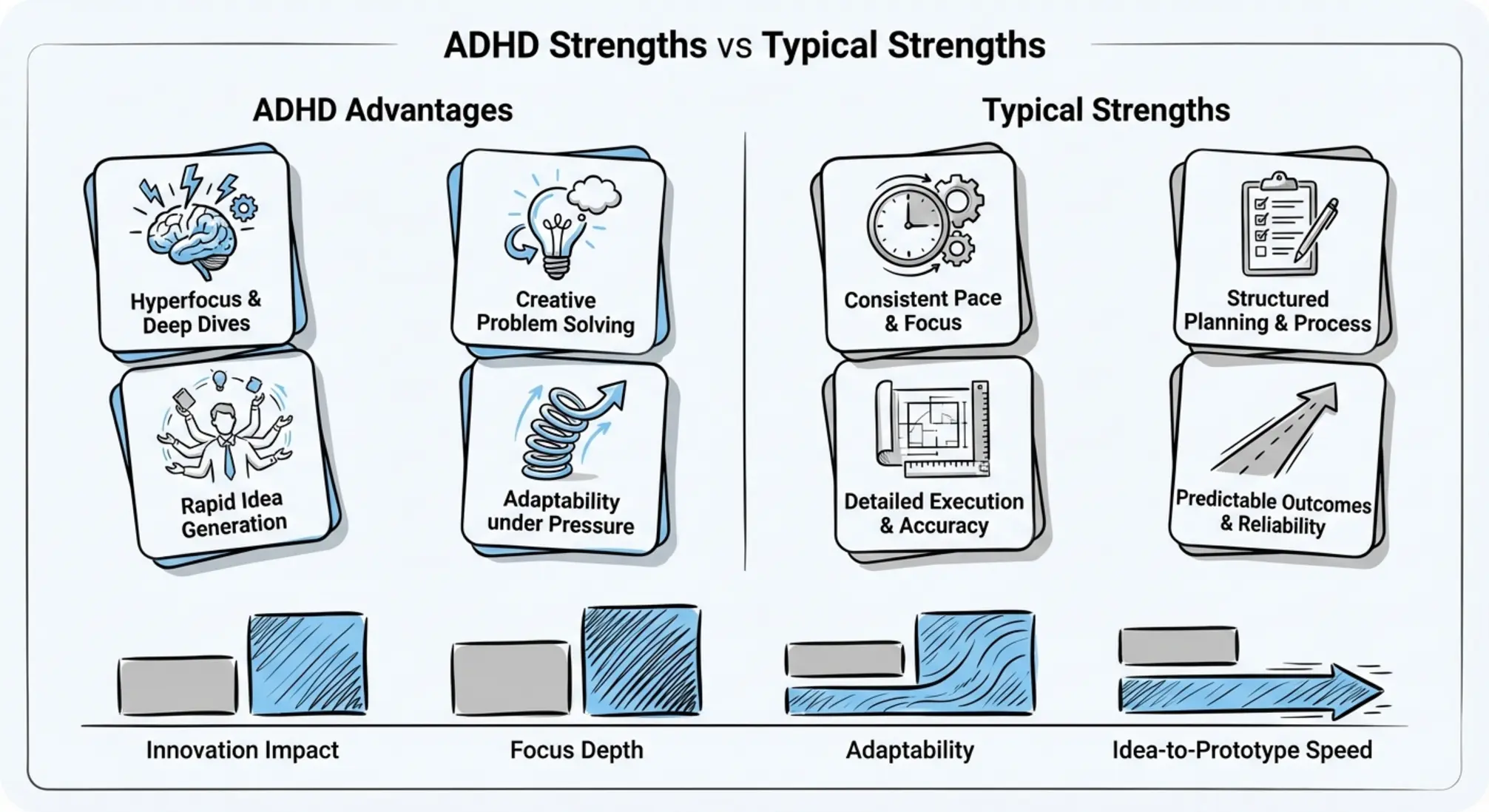
By proactively structuring your environment and tasks, you can activate and protect these intense periods of concentration, significantly boosting your capacity for innovation.
The entrepreneurial landscape is a natural habitat for the ADHD brain. Why? Because entrepreneurship demands rapid idea generation, comfort with novelty, and divergent thinking—all hallmarks of ADHD (Akili Interactive, Strawberryfield.salvationarmy.org.uk). Where others see obstacles, the ADHD brain often spots opportunities.
This isn't theory; it's evident in practice. Many successful entrepreneurs attribute their breakthroughs to their ADHD traits, leveraging their constant pursuit of stimulation, ability to connect disparate ideas, and willingness to take calculated risks. They see patterns, make intuitive leaps, and aren't bound by conventional wisdom in the way non-ADHD brains often are. Akili Interactive's survey states 51% identify increased creativity and 49% outside-the-box thinking as valuable traits.
Consider these points to harness this entrepreneurial creativity:
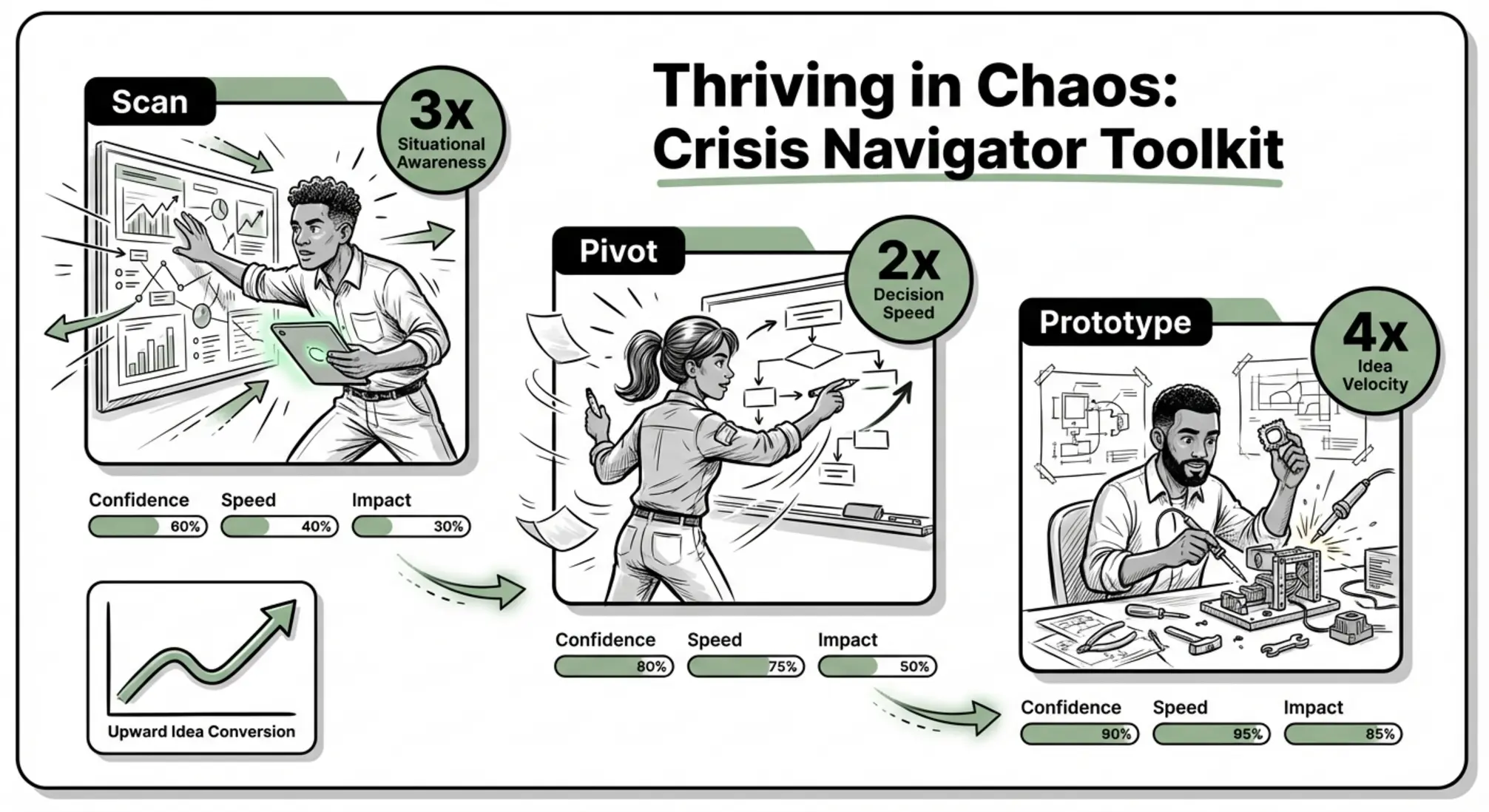
Most workplaces dread chaos. The ADHD brain? It can thrive in it. Far from being overwhelmed, individuals with ADHD often exhibit remarkable cognitive flexibility and quick decision-making under pressure. This isn't just about managing stress; it's about a unique ability to identify patterns and solutions in complex, fast-changing situations that would paralyze others.
Think of emergency services professionals, startup founders adapting to volatile markets, or project managers navigating unforeseen crises. The ability to rapidly pivot, synthesize new information, and solve problems on the fly makes the ADHD brain exceptionally well-suited for dynamic, high-stakes environments. The conventional workplace often advocates for rigid order, but innovation often flourishes where adaptability reigns.
To effectively harness this "Thriving in Chaos" advantage, a structured approach to rapidly unfolding situations can convert inherent adaptability into a strategic asset:

This framework allows you to convert the rapid cognitive flexibility inherent in ADHD into a powerful tool for effective, high-speed problem-solving.
We understand that ADHD also presents challenges time blindness, disorganization, emotional regulation difficulties. However, these aren't insurmountable barriers; they're areas where targeted strategies can protect and enhance your strengths.
The goal isn't to erase the "ADHD parts" of your brain; it's to build systems and habits that support its unique operation. Externalized systems, such as visual timers, structured routines, and technology tools, can effectively compensate for executive functioning differences. For example, using "time blocking" that leverages your hyperfocus intervals scheduling deep work sessions with planned breaks supports your natural cognitive rhythm rather than fighting against it.
By addressing these challenges strategically, you're not just coping; you're safeguarding the very conditions that allow your innovative and problem-solving superpowers to flourish.
For organizations and leaders, understanding and embracing neurodiversity isn't just about goodwill; it's a strategic imperative. The rising share of job postings mentioning neurodiversity-related accommodations indicates a growing employer awareness, yet many still misunderstand the profound advantages.
Companies that successfully integrate neurodivergent talent often experience boosts in innovation, problem-solving, and overall performance. When leaders create environments where team members can advocate for their needs without shame, and actively educate colleagues on ADHD strengths, they unlock a powerful competitive advantage.
Consider a "Neurodiversity-Friendly Workplace Checklist" for both individuals and employers:
For Individuals:
For Employers:
By actively fostering an inclusive culture, you’re not just accommodating; you’re setting the stage for unmatched innovation. This is how you unlock the full spectrum of human potential.
The narrative around ADHD is shifting. It's moving from a focus on deficits and limitations to an empowering recognition of unique cognitive strengths. The journey from evaluating options to making a confident decision about how to leverage ADHD in professional contexts begins with understanding: this isn't a condition to be hidden or merely 'managed.' It's a distinct cognitive profile with immense potential.
Your ADHD brain, with its capacity for hyperfocus, creative problem-solving, and adaptability in crisis, offers a powerful edge in today's dynamic professional world. By reframing ADHD from a challenge to a suite of superpowers, and by implementing targeted strategies, you can transform your personal and organizational outcomes.
Don't just overcome ADHD; leverage it. Embrace your neurodiversity, cultivate its strengths, and redefine what's possible in innovation and problem-solving. Ready to explore resources and connect with a community that understands and champions the ADHD advantage? Start by exploring our collection of articles on ADHD strengths in the workplace.
Understanding how ADHD translates into professional strengths can raise a lot of questions. Here are some of the most common ones we encounter when individuals and organizations evaluate this unique cognitive profile.
Hyperfocus is a distinct cognitive state more pronounced in individuals with ADHD, often triggered by intense interest or challenge (Child Mind Institute). While it can feel unpredictable, it's a profound ability to achieve deep, prolonged concentration, leading to exceptional output. The key is to learn to trigger and protect it intentionally, rather than waiting for it to happen. By structuring tasks that align with your interests and creating a distraction-free environment, you can significantly increase its reliability as a professional asset. It's not just occasional; it's a powerful tool with strategic application.
It starts with education and demonstration. Frame your ADHD traits in terms of tangible benefits:
Offer concrete examples of how your traits have led to successful outcomes. Share resources on neurodiversity in the workplace, and focus on collaborative solutions for any challenges your ADHD may present. The data supports you: nearly 98% of adults with ADHD recognize these workplace strengths.
It's common to feel overwhelmed, especially without proper coping strategies. "Thriving in Chaos" doesn't mean enjoying disorganization; it means your brain is uniquely equipped for rapid adaptation and problem-solving within dynamic environments. If you feel overwhelmed, it often points to a lack of external structure or coping mechanisms rather than an absence of the strength itself. Focusing on externalizing systems (like setting alarms, using visual cues, breaking down tasks) can help you manage the executive function challenges, freeing up your innate adaptability to shine.
Yes, absolutely. Roles that demand creativity, rapid problem-solving, adaptability, and high energy often align well with ADHD strengths. This includes fields like entrepreneurship, technology (especially coding, UI/UX design), creative arts, emergency services, sales, consulting, and project management in dynamic startups. Any role where "out-of-the-box" thinking and quick pivots are an asset, rather than a liability, tends to be a good fit.
Workplaces can make significant strides by adopting neuro-inclusive practices. This includes:
These practices don't just benefit individuals with ADHD; they enhance overall team innovation and productivity by tapping into a wider range of cognitive talents. The rising number of companies mentioning neurodiversity accommodations suggests this is becoming a crucial business strategy.