ADHD Executive Functioning Guide for Career Success
Learn ADHD executive function strategies to boost your career. Discover Kanban and Time Blasting to start tasks, manage time, and prevent burnout today.

You're a professional navigating the complexities of your career, and you're good at what you do. Yet, if you have ADHD, you've likely encountered a persistent, often frustrating challenge: the invisible barrier of executive dysfunction. It's not about lacking intelligence or capability; it's about a different operating system within your brain. You know the struggle—the brilliant ideas that never quite launch, the deadlines that loom menacingly, or the sheer mental effort it takes to keep track of multiple moving parts. You're constantly evaluating solutions, looking for something that just clicks for your brain.
This isn't about generic productivity hacks. This is about understanding the unique neurological landscape of the ADHD brain and equipping you with strategies tailored to externalize, support, and even leverage your executive functions for sustainable professional success. Think of it as upgrading your internal operating system with external tools designed specifically for you.
To genuinely master professional challenges, we first need to understand why they feel so challenging. Executive functions (EFs) are the high-level cognitive processes that manage our thoughts, actions, and emotions to achieve goals. For neurotypical individuals, these functions largely operate in the background. For those with ADHD, there's a significant difference. Research indicates that between 40% and 60% of adults with ADHD experience substantial impairments in EFs, often scoring 10-15 points lower on EF measures compared to their neurotypical peers. This isn't a moral failing; it's a neurological difference.
These differences manifest in several key areas crucial for professional life:
Traditional advice often assumes a neurotypical brain and can leave you feeling more frustrated. You don't need to "try harder"—you need targeted strategies that externalize these functions, providing scaffolding for your brain's unique architecture.
The goal here isn't to "cure" executive dysfunction; it's to build a robust external support system that acts as your auxiliary brain. Instead of relying solely on internal mental processes, we create environments and use tools that do the heavy lifting for you.
Project management for the ADHD brain needs to be visual, flexible, and iterative. Linear to-do lists can often feel overwhelming or quickly become obsolete. We need systems that reflect the dynamic, often non-linear, way an ADHD mind processes information.
Consider frameworks like Kanban boards or Trello, which offer visual cues and allow for easy manipulation of tasks. The key attributes to look for in any project management tool or methodology are:
When evaluating options, you'll want to compare how each system handles these core needs.
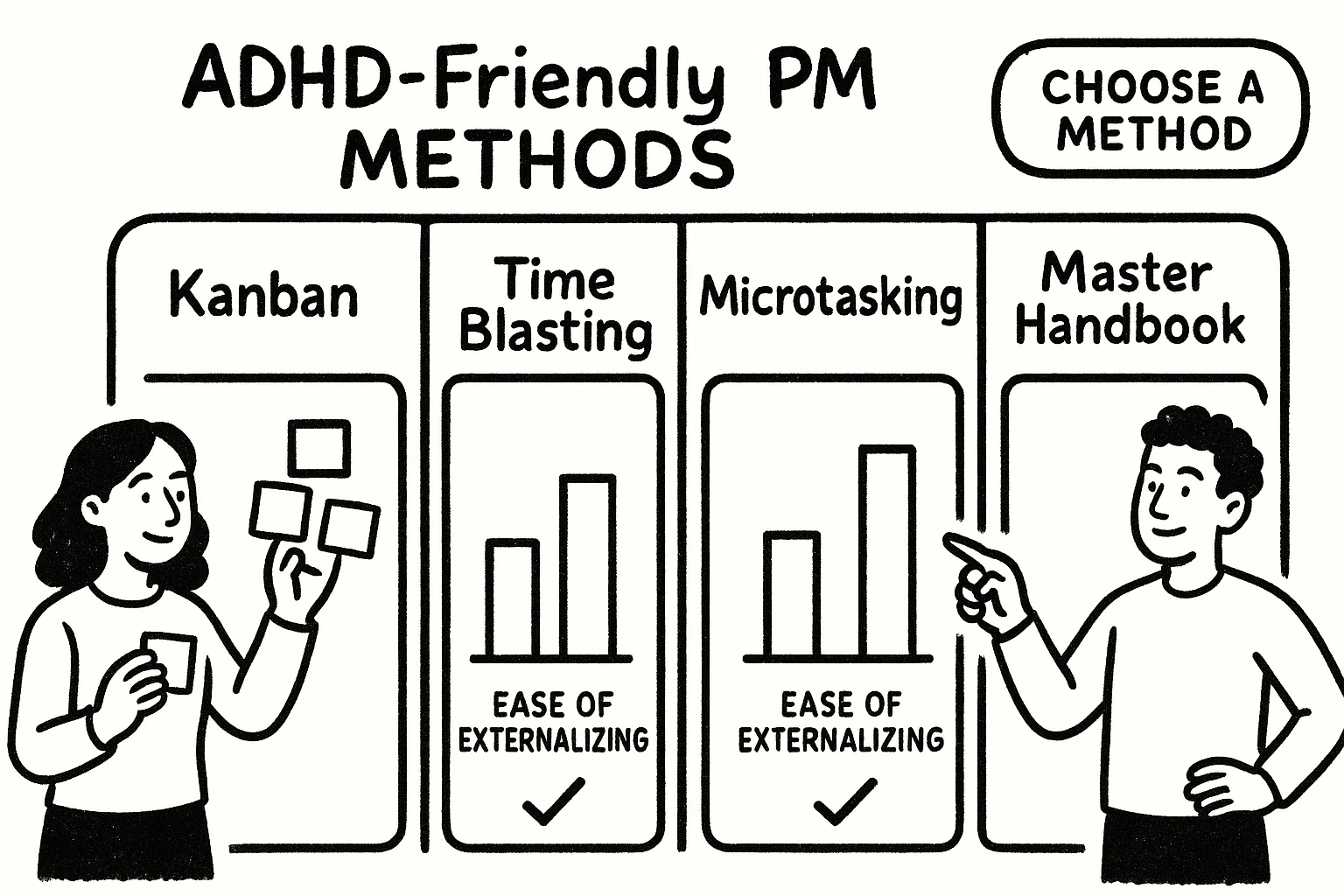
A practical approach: Start with a simple digital or physical Kanban board. Create columns like "Backlog," "To Do Today," "In Progress," "Waiting On," and "Done." Each task gets its own card. The satisfaction of moving a card to "Done" provides a tangible reward for your brain. For those larger, overarching tasks, consider ADHD-Friendly Project Management Methodologies.
"Time blindness" is a common ADHD experience, making traditional time management techniques frustratingly ineffective. Simply owning a planner won't solve the issue if you can't accurately estimate how long tasks will take or feel the urgency of an impending deadline. We need strategies that make time tangible and respect how your brain processes it.
Metrics demonstrate the power of such strategies:

This isn't about being rigid; it's about creating a structure that allows for flexibility without chaos.
Task paralysis and difficulty initiating work are hallmark challenges for many professionals with ADHD. The sheer magnitude of a task, fear of imperfection, or simply not knowing how to start can lead to hours of avoidance. This isn't laziness; it's a breakdown in the task initiation executive function. For a deeper dive into this, check out [Overcoming Task Paralysis: Initiating and Sustaining Focus].
Here are tailored strategies:
The key is to trick your brain into initiating work by reducing the perceived activation energy.

The narrative around ADHD often focuses on deficits, but that's only half the story. Many individuals with ADHD possess unique cognitive strengths that, when leveraged effectively, can become significant professional assets. When weighing solutions, consider those that help you amplify these strengths.
Hyperfocus—the ability to delve deeply into a task or interest for extended periods, almost to the exclusion of everything else—is often seen as a double-edged sword. While it can make you lose track of time or neglect other responsibilities, it also means you can achieve remarkable output and insight when directed.
Embrace hyperfocus as a superpower, and learn to summon it strategically.
The ADHD brain often excels at divergent thinking—generating multiple, varied ideas from a single starting point. This makes professionals with ADHD natural innovators and creative problem-solvers. In a rapidly changing professional landscape, this ability is invaluable.
Many with ADHD experience periods of intense energy and a natural inclination towards novelty and rapid adaptation. This makes them highly effective in fast-paced, dynamic roles where quick problem-solving and responsiveness are critical.
Sustainable success isn't just about productivity; it's about building resilience, managing emotional challenges unique to ADHD, and preventing burnout. This often represents an overlooked area in many external solutions.
Boredom for an ADHD brain isn't just mild disinterest; it can be excruciating, leading to restlessness, distraction, and an inability to focus. It's a significant cause of task switching and procrastination.
Working memory deficits are a core component of ADHD, making it challenging to hold information in mind, especially in busy professional settings. Traditional rote memorization is often ineffective. For detailed breakdown, consult [Memory & Recall Strategies in the Workplace for ADHD Adults].
Here's an example of practical, ADHD-focused memory tools:

Successful recall strategies for ADHD often rely on visual, spatial, and narrative hooks rather than purely auditory or abstract processing.
The constant effort to manage ADHD symptoms, coupled with societal expectations, often leads to a cycle of intense overfunctioning followed by severe crashes. This "ADHD burnout cycle" is characterized by hyperfocus, exhaustion, procrastination due to overwhelm, feelings of guilt, and then a pressured restart.
At My ADHD, we understand that living with ADHD is a journey unique to every individual. Our content isn't just informational; it's designed to resonate with the beautifully chaotic, endlessly fascinating, and sometimes exhausting mental internet of someone with ADHD. Every piece is crafted to be a trusted resource, providing insights you can return to again and again.
We believe in accessible insights that build confidence, speaking to you like a trusted advisor, not an academic journal. Our information is dense with value, free of corporate jargon, and structured for both quick understanding and deep dives. You're not looking for surface-level answers; you're looking for authoritative guidance from those who truly get it.
We aim to validate your experience, equip you with tailored strategies, and empower you to make confident decisions as you build a professional life that truly works for you. This means providing clear differentiation points from generic advice and supporting every claim with the latest research, distilled into actionable wisdom.
A: Most traditional productivity strategies are designed for neurotypical brains, assuming intact executive functions like effortless planning, consistent motivation, and accurate time perception. For professionals with ADHD, these underlying functions are often inconsistent due to neurological differences. Strategies like simple to-do lists or rigid schedules fail because they don't provide the external scaffolding or engage the brain's reward system in a way that resonates with ADHD. Our approach explicitly accounts for these differences, emphasizing externalization, visual cues, and interest-based motivation.
A: No. While we provide practical "hacks," our approach is fundamentally different. We ground our strategies in an understanding of the neurological basis of ADHD and executive dysfunction. The goal is not a quick fix but to introduce sustainable systems and mental models that work with your brain, not against it. We focus on building resilient habits and external tools that become a consistent support structure, rather than relying on fleeting bursts of willpower. The 30% rule, Time Blasting, and visual project management aren't just tricks; they're frameworks for long-term adaptation.
A: Many productivity solutions focus solely on symptom reduction. Our content, however, deliberately integrates modules on harnessing ADHD's inherent strengths—like hyperfocus, divergent creative thinking, and adaptability. By understanding how to strategically direct your hyperfocus, cultivate innovative problem-solving, and excel in dynamic environments, you can reframe ADHD traits from liabilities into powerful assets. We provide techniques to consciously channel these strengths for professional advantage, moving beyond a deficit-based mindset.
A: It's common for professionals with ADHD to feel this way after trying numerous strategies. The issue isn't your effort, but often the mismatch between the strategy and your neurotype. Our content differentiates by offering:
We encourage an iterative process of experimentation and self-compassion. It's about finding your unique combination of tools and understanding that consistency will look different for you, and that's okay.
A: AI offers incredible potential for supporting executive functions by automating repetitive tasks, summarizing information, and providing reminders. Start small. For example, use AI to:
The key is to use AI as a co-pilot, a tool that externalizes part of your executive function, rather than trying to learn an entirely new, complex system at once. We’ll delve deeper into specific, ADHD-friendly AI tools in future content.
The journey to professional success with ADHD is about understanding your unique brain, externalizing your executive functions, and leveraging your inherent strengths. It's not about changing who you are, but about optimizing how you operate. You have the intellect, the drive, and the unique perspective to succeed—you just need the right framework.
Explore our other deep dives into [ADHD-Friendly Project Management Methodologies], [Overcoming Task Paralysis: Initiating and Sustaining Focus], [Time Management for the ADHD Professional: Beyond Planners], and [Memory & Recall Strategies in the Workplace for ADHD Adults] to continue building your personalized toolkit. We're here to provide the insights and strategies you need to thrive.