ADHD Emotional Resilience Step by Step Guide to Bounce Back
Discover ADHD emotional resilience strategies to recover from setbacks and burnout. Learn how to unmask, outsource tasks, and build a custom rest plan.
Welcome to the wonderfully chaotic, endlessly fascinating, and sometimes profoundly exhausting "mental internet" of someone with ADHD. If you've found your way here, chances are you're not just looking for another article about coping with ADHD. You're searching for something deeper: a way to move beyond merely surviving the daily grind and truly thrive, even when setbacks hit hard. You're looking for genuine emotional resilience, a trait often overlooked in ADHD discussions, yet one that's absolutely crucial for long-term well-being.
You know the feeling. That deep, bone-weary exhaustion that goes beyond lack of sleep. The one that tells you you're not just tired, but fundamentally depleted. This isn't just general burnout; it’s ADHD burnout, and it hits differently. It’s a vicious cycle that nearly 93% of adults with an ADHD diagnosis experience, a staggering figure compared to the 30% of the general population who face similar struggles. This isn't a sign of weakness; it's a testament to the immense, often invisible, effort your brain expends daily. What if you could build a mental toolkit specifically designed for your unique brain, allowing you to bounce back with genuine strength, rather than just patching things up? Let's navigate this journey together.
Understanding why ADHD brains are susceptible to burnout is the first step toward building resilience. It’s not about willpower; it’s about neurobiology. Your brain operates with what many experts call a "cognitive tax," meaning it works significantly harder than a neurotypical brain to manage focus, regulate emotions, and execute daily tasks.
Several intertwined factors contribute to this unique vulnerability:
These factors don't just make you tired; they create a unique vulnerability to burnout that requires a neuro-affirming approach to resilience.
This isn't about blaming your brain; it’s about understanding it. When you grasp these underlying mechanisms, you can release the self-blame and begin to develop strategies that genuinely support your unique wiring.

ADHD burnout isn't a sudden event; it's often a cumulative process, a "burnout spiral" defined by a pattern of hyperfocus followed by a crash, often leading to guilt and shame. Understanding this cycle and identifying your unique triggers is vital for intervention.
Common ADHD-specific triggers for this spiral include:
Recognizing these triggers isn’t about self-pity; it’s about self-awareness. It's about seeing your experiences not as character flaws but as predictable responses to specific stimuli for an ADHD brain. This awareness empowers you to proactively address them.
Moving beyond understanding to action, building emotional resilience with ADHD means equipping yourself with practical, neuro-affirming tools. This isn't about forcing yourself to act neurotypically; it's about leveraging your unique strengths and creating systems that truly support you.
Here are key elements for your ADHD emotional toolkit:
Traditional approaches often emphasize "shaking it off" or "improving self-discipline." For ADHD, this can be counterproductive. Self-compassion is a foundational element for both recovery and sustained resilience. It means treating yourself with the same kindness and understanding you would offer a friend.
Practical exercises:
Rest isn't a luxury; it's a non-negotiable component of resilience, especially for the ADHD brain. Burnt-out ADHDers often find themselves in a cycle of pushing until they crash. The goal is to integrate strategic recovery before overload hits.

The constant effort to hide your ADHD traits leads to significant energy drain. "Unmasking" is about safely and strategically reducing these behaviors, allowing yourself to be more authentic. Neurodivergent Insights explicitly highlights unmasked time as crucial for recovery from burnout.
You don't have to do it all yourself. Recognizing where your executive functions falter allows you to build external systems of support.
While mindfulness is often recommended, traditional sitting meditation can be challenging for the ADHD brain. Adapt for your needs.
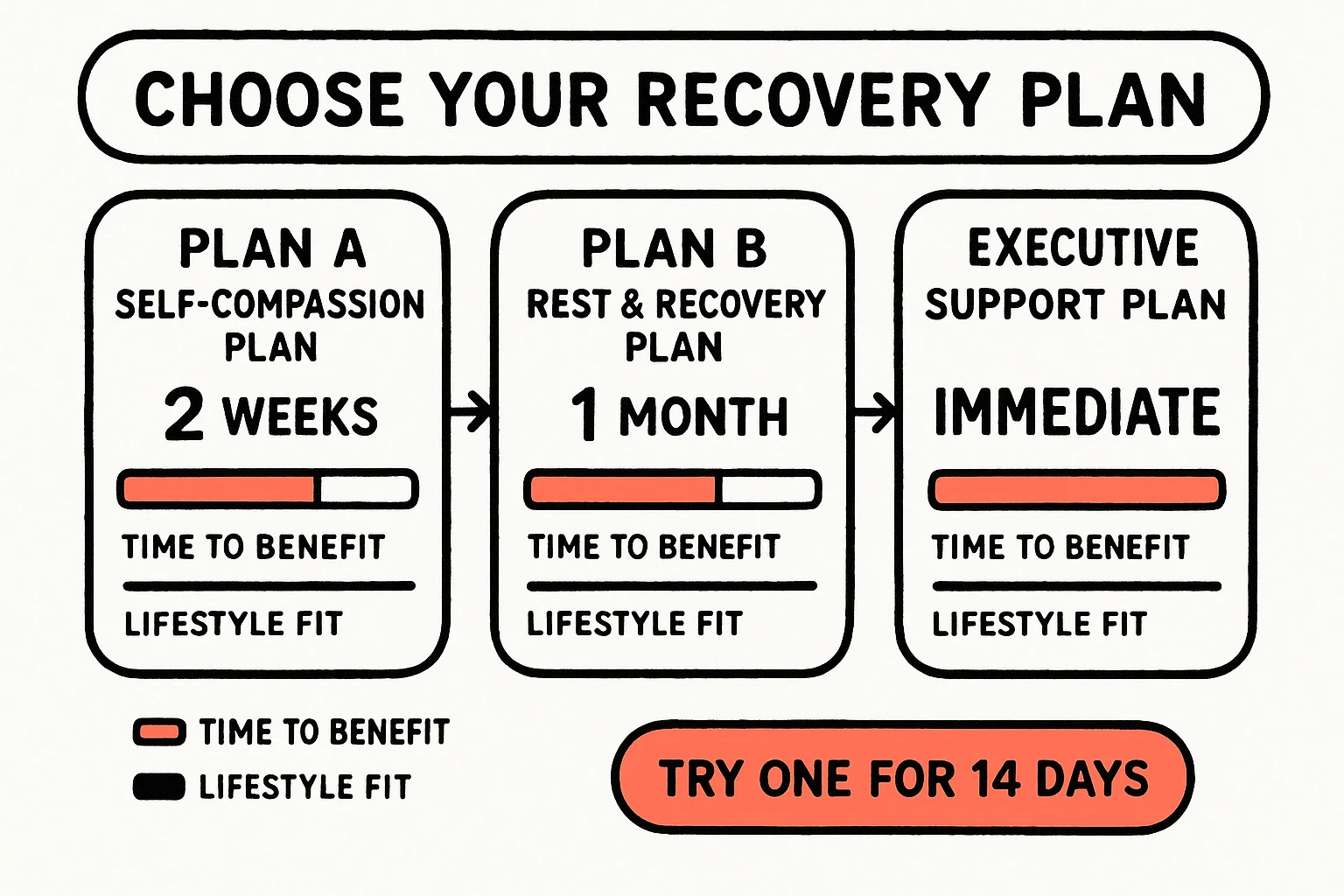
With these tools at your disposal, how do you start? The beauty of an individualized strategy is that there’s no single right path. Below, compare three recovery plans tailored for different scenarios, considering the time-to-impact and lifestyle fit.
Sometimes, the best way to believe in your own power to bounce back is to hear from those who have walked a similar path. These are not grand heroic tales, but relatable moments of resilience that highlight the power of neuro-affirming strategies.
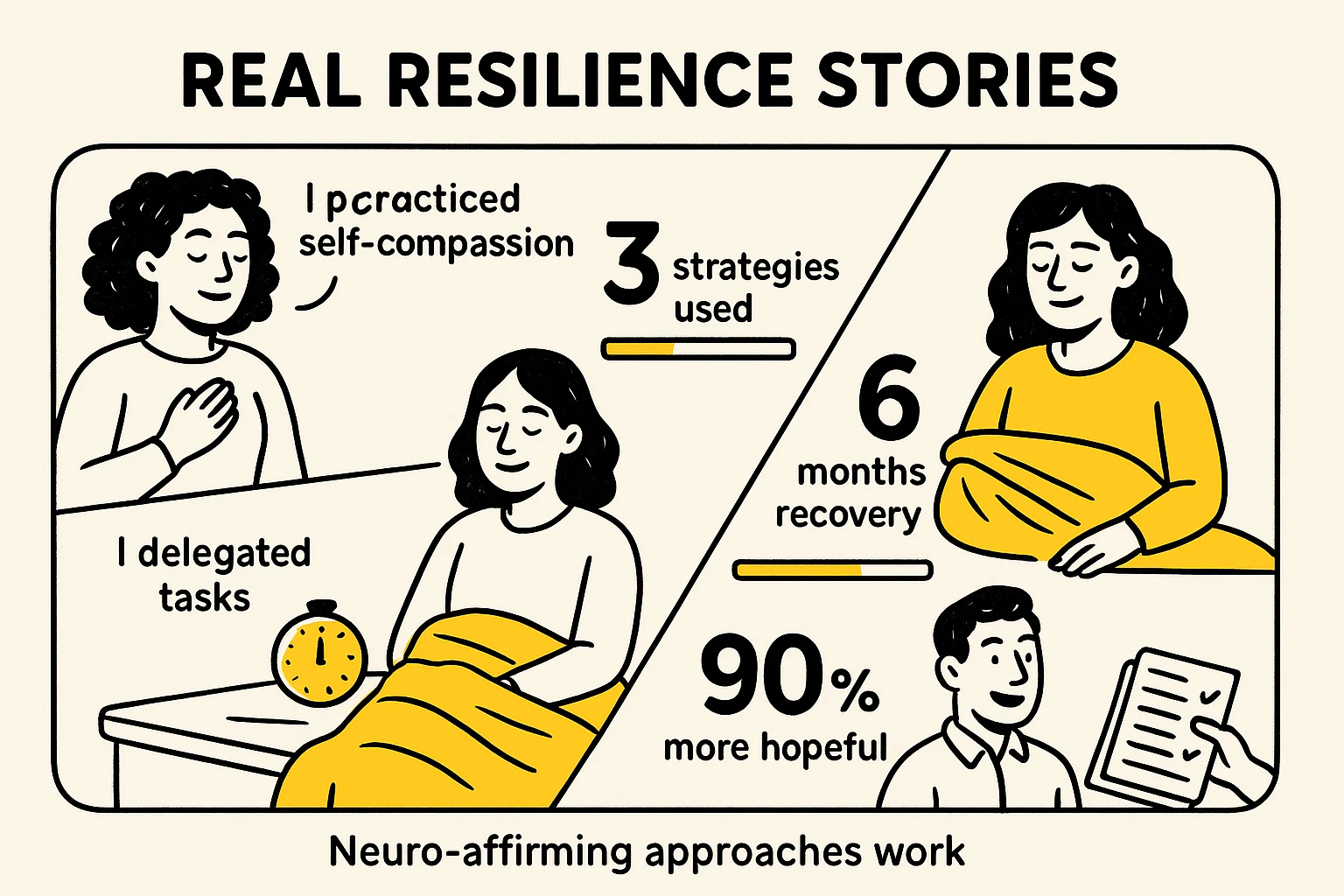
Story 1: "Maria's Return to Art"Maria, a graphic designer with ADHD, experienced severe burnout after trying to keep up with demanding client expectations and masking her ADHD at work for years. She finally hit a wall where she couldn't even design for pleasure. During her recovery, she consciously created a "sensory retreat" in a corner of her home – a quiet space with soft lighting, weighted blanket, and noise-canceling headphones. She started with 10-minute "sensory breaks" daily. After a month, she found herself sketching for fun again, something she hadn't done in years. The key: respecting her sensory needs, which directly fueled her creative energy and led to her eventually launching her own, ADHD-friendly design studio.
Story 2: "David's Delegation Discovery"David, an entrepreneur, was constantly overwhelmed by the minutiae of running his business. He found himself hyperfocused on small details while critical tasks piled up. His burnout manifested as extreme procrastination and self-loathing. His shift came when he invested in a virtual assistant (VA) to handle administrative tasks he found excruciating. Initially, he felt guilt ("I should be able to do this myself!"), but applying self-compassion and understanding his executive function challenges allowed him to embrace the delegation. Within three months, his stress levels plummeted, and he could dedicate his hyperfocus to strategic growth, leading to a 30% increase in profit that year.
Story 3: "Chloe's Unmasking in Academia"Chloe, a university lecturer, was exhausted from trying to appear perfectly organized and attentive in front of her students and colleagues. Her ADHD meant her mind often raced, and she struggled with linear presentations. Her breakthrough came from "unmasking." She started by explicitly telling her students, "My brain works a little differently, so I might pace, or occasionally lose my train of thought, but I'm fully engaged and present." She also started teaching some concepts through interactive, movement-based activities. The result? Not only did her burnout symptoms decrease, but student engagement actually improved, and Chloe felt a profound sense of liberation.
These stories highlight that recovery and resilience are not about becoming a different person, but about developing the courage to be authentically you, and building systems that work with your beautifully chaotic brain.
While self-help strategies are invaluable, sometimes the journey requires guidance from others. Knowing when to seek professional support is a mark of strength, not weakness.
Here are some common questions many individuals with ADHD have when navigating burnout and building resilience:
Yes, profoundly so. While general burnout shares symptoms like exhaustion and cynicism, ADHD burnout has unique underlying neurobiological causes tied to executive dysfunction, dopamine dysregulation, emotional dysregulation, and the pervasive effort of masking. These lead to specific triggers and recovery needs. The sheer prevalence – 93% of adults with ADHD experiencing it vs. 30% of the general population – underscores its distinct nature and severity.
There's no single timeline, as it varies widely based on severity, individual circumstances, and the effectiveness of strategies implemented. Minor burnout might improve within weeks with focused rest and self-compassion. Severe, chronic burnout can take months or even years to fully recover from. The process involves not just resting, but fundamentally retraining habits, reshaping environments, and building sustainable resilience strategies. It's a journey, not a quick fix.
Absolutely, and it's a critical part of long-term resilience. "Unmasking" isn't about abandoning all social conventions; it's about strategically reducing the exhausting effort of constantly suppressing your authentic self. This means identifying safe spaces and people where you can be fully yourself, communicating your needs effectively, and gradually integrating more neuro-affirming behaviors into your life without fear of judgment. It conserves massive amounts of mental energy previously spent on performative neurotypicality.
This is a common and challenging hurdle. Start small. Recognize that self-judgment is often an internalized response to a lifetime of criticism, not a reflection of your worth. Practice simply noticing the critical thought without engaging with it. Then, consciously reframe it with curiosity: "That was an ADHD moment. What does my brain need right now?" Journaling, mindful self-talk, and reading about others' ADHD experiences can help normalize your struggles and foster empathy for yourself. Remember, self-compassion isn't about excusing all behavior; it's about understanding the underlying reasons and responding with kindness, which paradoxically leads to more effective change.
This is a classic burnout paradox! The feeling of not having time for rest is often a symptom of severe burnout itself. It’s crucial to reframe rest as proactive, productive work – not a reward for completing tasks, but a vital input that enables you to function. Start with micro-breaks. Can you sneak 5 minutes of sensory rest? 10 minutes of a movement break? Can you outsource one small task this week? Even small, intentional acts of strategic rest accumulate. Identifying your most impactful "rest type" (e.g., mental, emotional, sensory) and carving out small, non-negotiable pockets for it throughout your day is more powerful than waiting for a large, elusive block of "free time."
Emotional resilience for the ADHD brain isn't an elusive concept; it's a learnable skill. It requires moving beyond traditional coping mechanisms and adopting a deeply neuro-affirming approach that understands and works with your unique wiring. By decoding the "cognitive tax," recognizing burnout triggers, and equipping yourself with an ADHD-specific emotional toolkit – one built on self-compassion, strategic rest, authentic unmasking, executive function outsourcing, and tailored emotional regulation – you can cultivate genuine mental toughness.
You are not broken; your brain is simply wired differently, and that's a strength when understood and supported. This journey is about empowering yourself to bounce back from setbacks, not just to survive, but to truly thrive in your beautifully chaotic, endlessly fascinating life. Start small, implement one new strategy from your toolkit today, and begin to build a foundation for lasting well-being. Your resilient future awaits.