ADHD Career Guide Align Work with Your Authentic Brain
Build an ADHD career that leverages hyperfocus and creativity to boost productivity and satisfaction. Learn how to find roles and ask for accommodations.

For too long, the narrative around ADHD in the workplace has focused on what needs to be "fixed"—on challenges to be overcome, deficits to be managed. If you’re an adult with ADHD, you’ve likely encountered countless articles and resources detailing coping mechanisms, time management hacks, and ways to minimize distractions. These approaches, while well-intentioned, often miss the crucial point: what if your ADHD isn't a deficit to overcome, but a unique neurodevelopmental difference that, when understood and leveraged, can be a profound asset in your career?
The truth is, many professionals with ADHD aren't just looking to survive their workday; they're looking to thrive. They seek not merely accommodations to mitigate struggles, but ways to align their authentic ADHD brain with a career path and work environment that truly celebrates their neurodiversity. This isn’t about fitting a square peg into a round hole; it's about redesigning the hole, or better yet, finding a space where square pegs are exactly what's needed.
We understand you're actively evaluating how to bridge the gap between your unique cognitive style and your professional aspirations. This guide is crafted to move you beyond basic coping strategies, offering strategic frameworks and actionable insights to help you build a career that truly resonates.
The statistics can paint a daunting picture: approximately 14.1 million U.S. adults with ADHD experience career struggles, facing higher rates of job instability and impulsive quitting. It’s easy to feel like you’re constantly playing catch-up. However, this narrative overlooks a critical truth: 98% of adults with ADHD recognize strengths like creativity and empathy within themselves. These aren’t just pleasant tidbits; they are powerful competitive advantages in today's rapidly evolving job market.
The conversation needs to shift from merely managing symptoms to strategically harnessing the unique capacities of the ADHD brain. We’re talking about hyperfocus—the ability to dive into a task with unparalleled intensity—innovative problem-solving, resilience in high-pressure situations, and boundless creativity. These are the traits that can drive entrepreneurial ventures, excel in dynamic roles, and spark groundbreaking ideas.
Finding career alignment begins with understanding your unique cognitive wiring—your "ADHD DNA." This means moving beyond generic job descriptions and drilling down into what truly energizes your brain, taps into your hyperfocus, and minimizes your executive function challenges.
Consider the spectrum of ADHD-friendly roles. Are you drawn to structured environments that provide clear parameters, allowing you to excel within defined boundaries? Or perhaps your brain thrives in hybrid roles, blending structure with dynamic, ever-changing tasks that prevent monotony? Then there are fluid roles, where autonomy, novelty, and the freedom to pursue multiple interests are paramount.
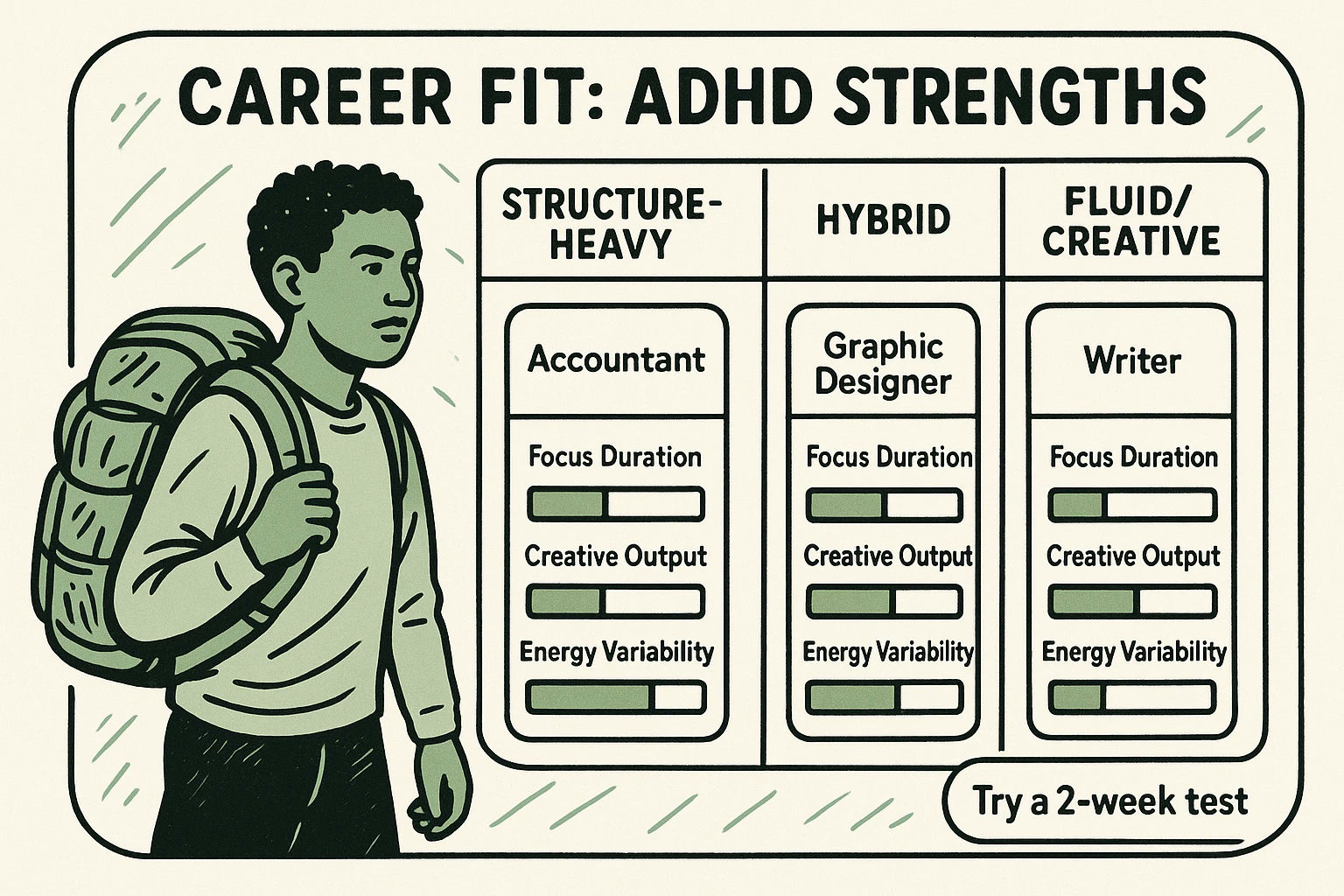
Identifying these preferences isn't just about avoiding burnout; it’s about unlocking sustained engagement and high performance. For example, roles requiring intense focus on novel problems, creative brainstorming, or rapid adaptation to new information often play directly into ADHD strengths. Think about industries like tech innovation, project management in dynamic fields, creative arts, or even certain areas of crisis management.
While many existing resources focus on basic coping mechanisms, we advocate for proactively seeking or shaping roles that naturally leverage your unique cognitive profile. This means asking: "Where does my brain naturally excel and feel most alive?" rather than "How can I force my brain to fit into this conventional role?"
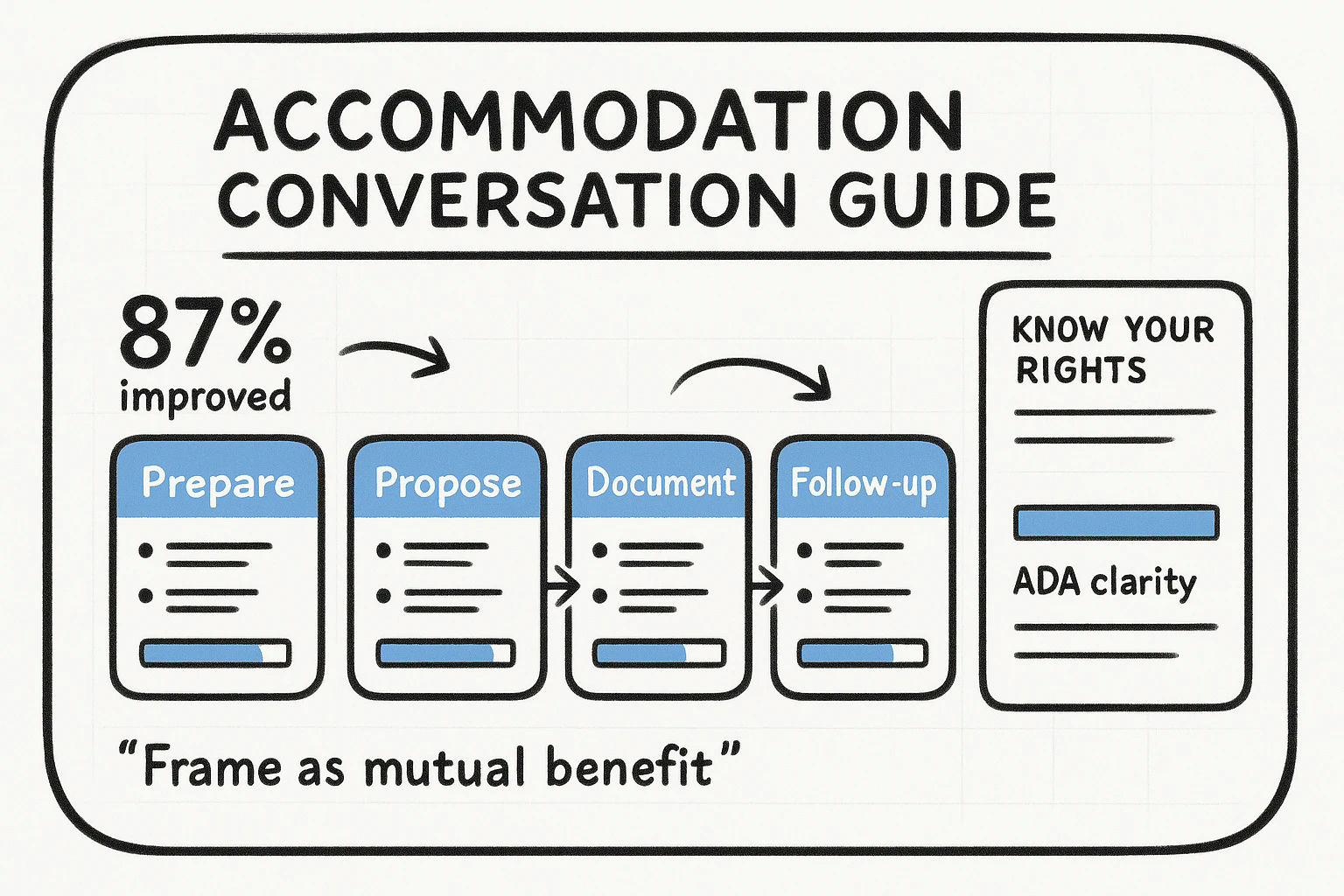
Navigating workplace accommodations can feel like a minefield. Standard lists of accommodations and legal discussions under the ADA (which you can find detailed on sites like askjan.org or dol.gov are a valuable starting point. However, true advocacy goes beyond knowing your rights; it involves strategic communication and a nuanced understanding of how to reshape your environment for mutual benefit.
The decision of when or if to disclose your ADHD is deeply personal and depends heavily on your workplace culture, your relationship with your manager, and your comfort level. If you choose to disclose, framing your needs as opportunities for enhanced productivity and team success can be incredibly powerful. Instead of saying, "I need a quiet space because my ADHD makes me distracted," consider, "A dedicated focus zone would significantly boost my ability to deliver high-quality work, benefiting the team's project timelines."
The workplace is evolving, with neurodiversity-inclusive job postings nearly tripling in recent years. This indicates a growing awareness and openness. Tactical communication requires preparation:
Even for those who manage their ADHD without medication, tailored environmental adjustments and supportive structures are crucial. This might include "body doubling"—working alongside someone else, even virtually—to create external accountability, or leveraging AI tools that personalize task management and communication support. The goal is to create psychological safety and flexibility, which are critical for neurodivergent employees to thrive.
For many with ADHD, traditional corporate structures can feel constricting. The very traits often perceived as challenges—like a tendency towards novelty, risk-taking, and hyperfocus on passion projects—are the bedrock of successful entrepreneurship. This isn't a niche idea; it’s a powerful alignment.
The ADHD brain can be an entrepreneurial powerhouse. The ability to connect disparate ideas, pivot quickly, embrace creative problem-solving, and delve deeply into areas of intense interest (hyperfocus) are invaluable assets for founders. Many successful entrepreneurs with ADHD aren’t just "managing" their condition; they're actively leveraging it.
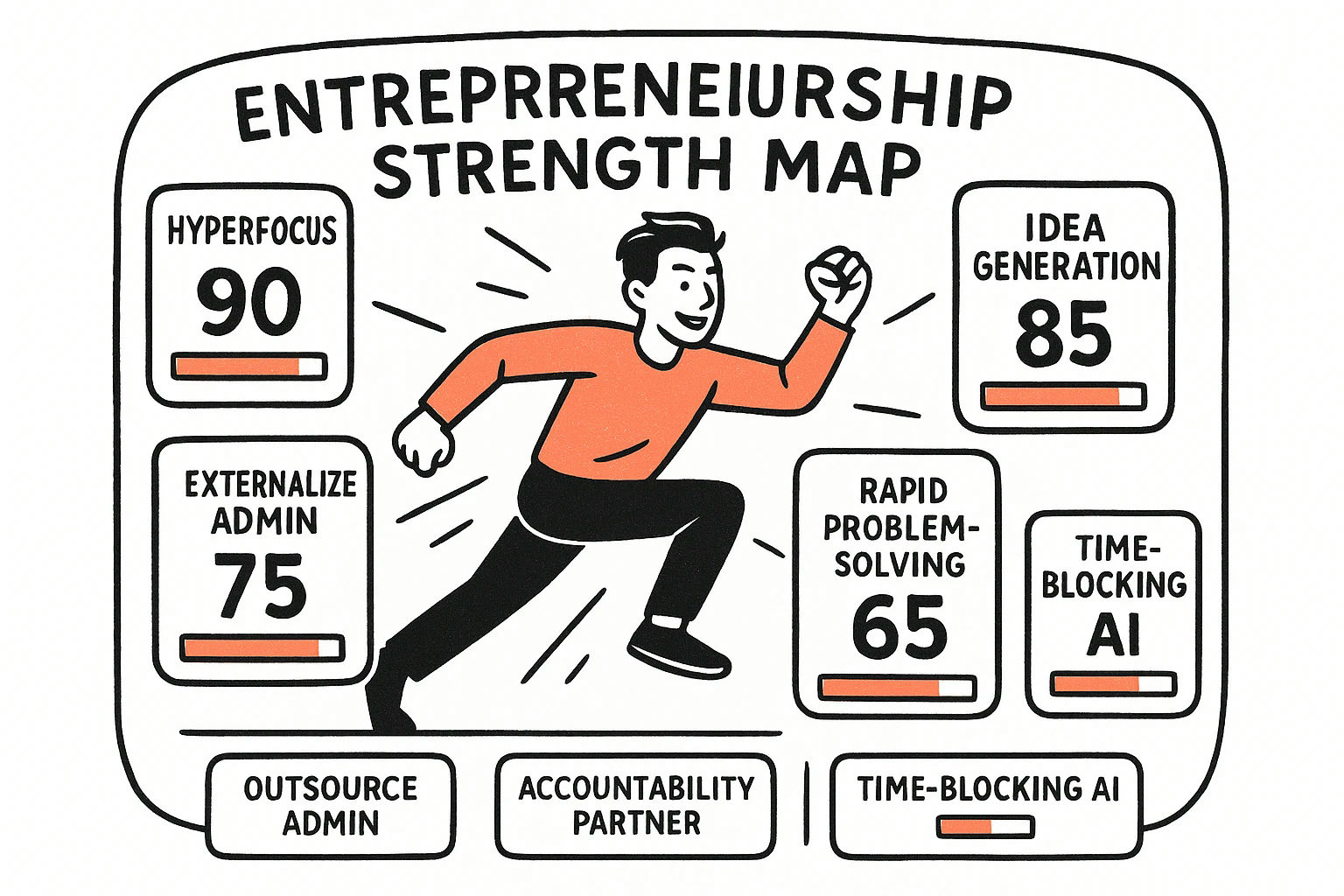
The key to entrepreneurial success with ADHD lies in intentionally structuring your business to support your brain. This means:
Entrepreneurship offers the ultimate flexibility to design a work environment that aligns with your brain, rather than forcing your brain to contort to an existing one.
Traditional productivity advice often clashes with the ADHD brain. The 9-to-5, linear task completion models rarely account for the non-linear, bursts-and-lulls nature of ADHD focus. Instead of fighting your brain, it’s time to redefine productivity on your own terms.
This involves experimenting with frameworks that genuinely support your executive functions, rather than demanding an impossible level of sustained, monotonous attention. Consider:
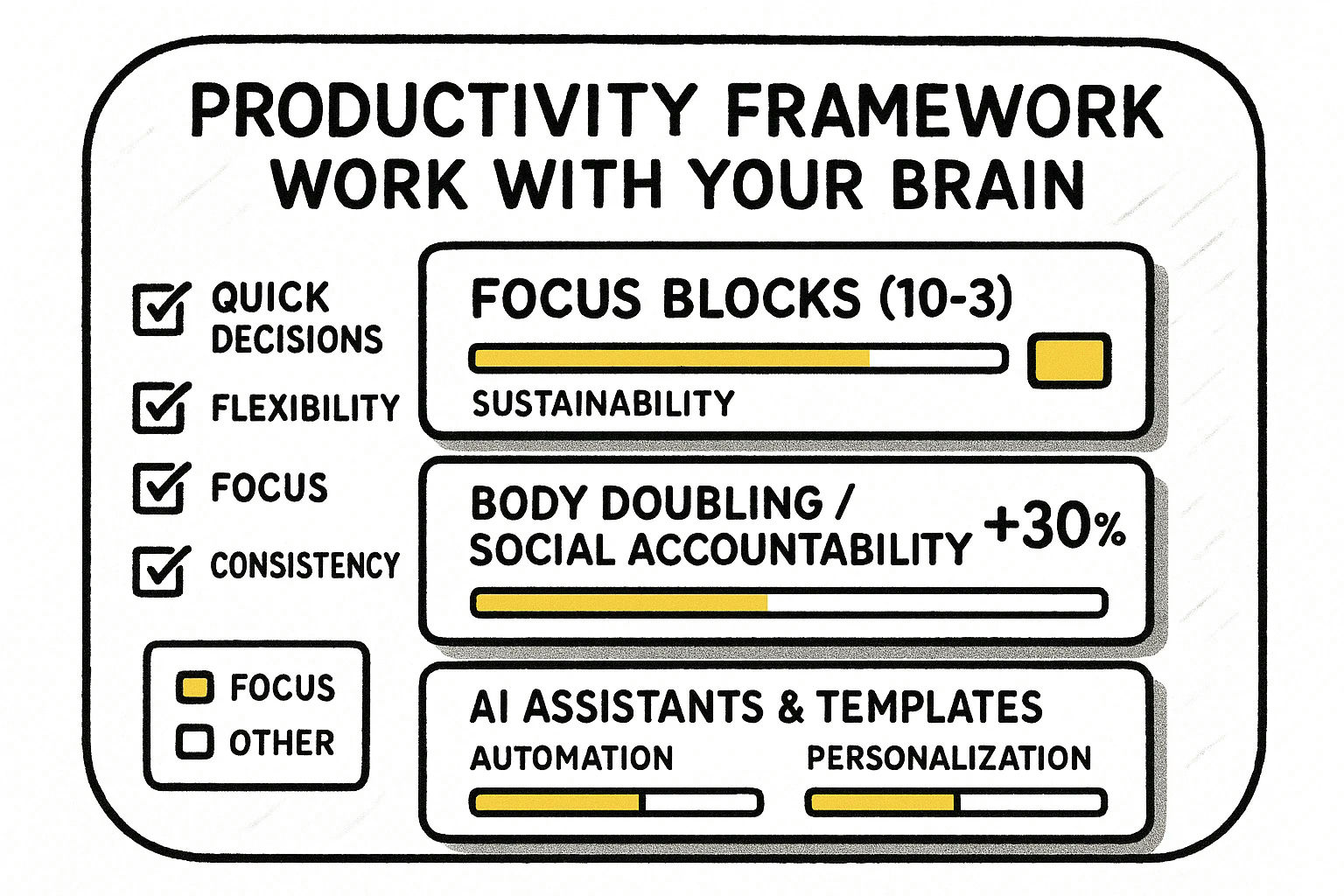
Environmental design also plays a crucial role. This means creating a physical and digital workspace that minimizes distractions and maximizes flow. It could be as simple as dedicated "focus hours," using noise-canceling headphones, or leveraging visual cues to support task initiation and completion. For more personalized strategies, dive into our extensive resources.
Yes, in many regions, including the U.S. under the Americans with Disabilities Act (ADA), ADHD is considered a disability. This means employers are legally obligated to provide reasonable accommodations unless doing so would cause undue hardship. However, the decision to disclose is personal; it's about navigating legal protections with practical career considerations.
While legal avenues exist, the first step is often open communication. Frame requests in terms of productivity and mutual benefit. If initial conversations are difficult, consider involving HR or a disability advocacy service like the Job Accommodation Network (askjan.org). Document all communications.
Start with self-assessment: what are your hyperfocus areas? What common themes emerge in your peak performance moments? Consider roles with high novelty, diverse tasks, creative problem-solving, or a strong sense of purpose. Fields like technology, arts, project management, and entrepreneurship often offer greater flexibility and intellectual stimulation.
Absolutely. Many ADHD traits—creativity, resilience, ability to hyperfocus on passion, and comfort with risk—are highly beneficial for entrepreneurship. The key is to build a business structure that supports your executive functions, perhaps through outsourcing, automated systems, and strong accountability partners.
work best for an ADHD brain?Unlike conventional advice, ADHD-friendly productivity focuses on working with your brain's natural rhythms. This includes using interest-based task scheduling, leveraging hyperfocus, employing visual cues for task management, and embracing flexible work structures like the "10-2 Rule" (short, focused bursts with micro-breaks). Exploring AI-powered tools can also offer personalized support for executive functions.
You're poised at a critical juncture, evaluating how to build a career that truly resonates with your unique ADHD brain. This isn't about fitting in, but about standing out—about harnessing your neurodiversity as an unparalleled asset.
We invite you to explore our comprehensive resources, dive deeper into the content that spoke most directly to your needs, and begin to actively design a professional life where your authentic self is not just accepted, but celebrated. Your journey towards a thriving, neurodivergent-affirming career starts here.